The poor woodcutter and his wife as spouses
The Most Precious of CargoesThe Poor Woodcutter and the Poor Woodcutter’s Wife begin as spouses bound by poverty but divided by what childlessness means to them. Their marriage is tested when the Poor Woodcutter’s Wife takes in a baby abandoned from a cargo train: what first appears to be an insurmountable conflict becomes a gradual, hard-won family bond, and ends in his violent sacrifice to protect her and their daughter.
Marriage Under Hardship
During the Second World War, the Poor Woodcutter is conscripted into public works serving the occupying army. From dawn to dusk, the Poor Woodcutter’s Wife gathers wood in the forest, often without enough to provide for their humble household. They have no children to feed, a circumstance the Poor Woodcutter treats as a blessing; he thanks heaven for it each day. His wife, by contrast, secretly mourns their childlessness. She has no child to care for and, as the story emphasizes, no child to love.
Her longing becomes an unshared part of their marriage. The Poor Woodcutter’s Wife prays to heaven, the gods, the wind, rain, trees, and sun for a child, while the Poor Woodcutter’s gratitude for their childless state points in the opposite direction. As the years pass, she comes to feel that the powers she has addressed are conspiring with her husband to deny her a child. The difference is not presented as a settled debate between them so much as a private sorrow on her side and a practical relief on his, within a life already pressed by hunger and cold.
The Baby and the Rupture
When the Poor Woodcutter’s Wife finds the baby in the snow, she immediately embraces the role she has long desired. The child’s hunger makes that joy urgent and frightening: she has no milk, and the baby’s need cannot be answered by affection alone. She tries cooking water and kasha, soothing the child with her finger and then feeding her what she can. The child calms, and the Poor Woodcutter’s Wife sings a lullaby that calls her “my little cargo,” “my own little package,” and “my own little child.” Her new motherhood begins in improvised care, not in any assurance that she can keep the baby alive.
The Poor Woodcutter responds first by trying to return the child to the railway line. The Poor Woodcutter’s Wife throws herself at him and blocks his way, insisting that abandoning the baby would mean casting her beneath the train’s wheels as well. He stops and hands the child back to her. The narration reveals that the baby is a girl, changing the woodcutter’s description of the little cargo from a boy to a girl as she passes between the spouses amid their struggle.
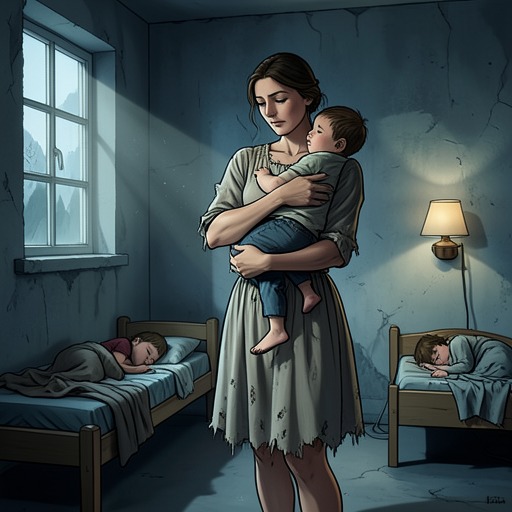
His retreat is not acceptance. When the Poor Woodcutter’s Wife says their daughter will bring joy to both of them, he refuses that joy and says he does not want to hear or see the child. She moves with the baby into the woodshed, where there are no floorboards, rather than surrender her. Yet he tosses her a tattered bearskin against the cold and warns her not to catch one. The gesture does not erase his rejection, but it complicates it: even at the point of separation, his practical concern for his wife persists alongside his refusal of the child.
From Resistance to Shared Parenthood
The Poor Woodcutter’s Wife does not treat her husband’s rejection as the final word. Knowing that the baby will die without milk, she takes her daughter to the secluded forest grove where a solitary man keeps a goat. When he says the child’s death would not matter because she could have another, the Poor Woodcutter’s Wife answers that she is no longer young and that the cargo train’s god entrusted this child to her. She offers to bring firewood every day in exchange for two mouthfuls of milk. The arrangement gives her daughter a means to survive, but it also shows how much of the work of making their new family possible falls on the wife.
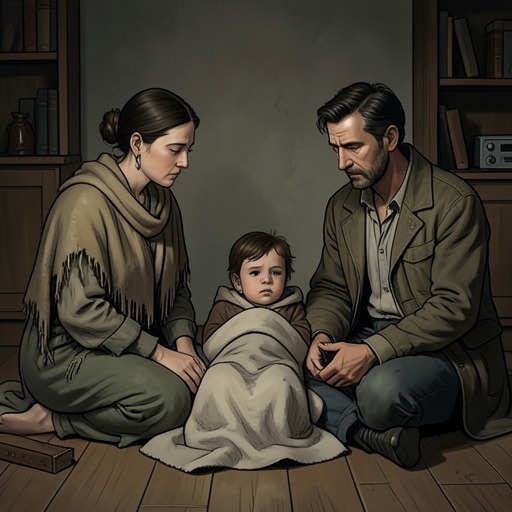
At home, the baby’s crying eventually brings the Poor Woodcutter to the point of raising his hand against her. The Poor Woodcutter’s Wife catches his calloused hand and holds it against the child’s chest. As he struggles and denounces the baby as a demon and a cursed creature, she asks him to feel the tiny heart beating beneath his palm. Her action makes the child’s living body the answer to the language that denies her humanity. The moment does not instantly resolve the marriage’s conflict, but it turns the husband’s hand from a threatened blow into contact with the baby.
The following day, the Poor Woodcutter feels that heartbeat wherever he places his hand. Tenderness takes the place of his earlier hostility: he too begins calling the child his little cargo, and when he is alone with her, he offers a finger that she grabs and will not release. The change becomes visible when the girl pulls herself upright using the patched knee of his trousers. He calls for the Poor Woodcutter’s Wife to come and see; after the child lets go, falls, and laughs, he scoops her up and celebrates her as if she were a trophy. Their response is shared now: the Poor Woodcutter’s Wife claps, and he exults in the child’s first unsteady attempt to stand.
A Family Made, and Lost
In the days that follow, the spouses experience their circumstances differently because they are no longer facing them as a childless couple. The war remains, as do cold, hunger, and poverty, but the three of them share a happiness that makes their world seem lighter and more secure. The Poor Woodcutter works with greater zeal and strength, and his comrades become more welcoming. The child has not lifted the burdens around the marriage; she has altered what the spouses have to live for within them.
That family life is shattered when a comrade from the building site arrives with militiamen. The Poor Woodcutter calls for his wife to prepare the child and bring the visitors a drink, but when the child reaches out to him, he takes up his ax and attacks the distiller. He then strikes one of the militiamen and turns against the other, giving the Poor Woodcutter’s Wife the chance to escape with their daughter. His last command to her is to run and save herself, followed by a plea that their little cargo live. The protection he offers is no longer reluctant or divided: he puts his own life between his family and the men threatening them.
Afterward, the Poor Woodcutter’s Wife flees with their daughter. The marriage’s shared home and brief period of happiness are left behind, and the story gives no reunion between the spouses. His final words nevertheless preserve the change in their relationship: the man who once insisted he did not want to see or hear the child dies urging his wife to save her. Their marriage has moved from opposing meanings of childlessness, through a painful struggle over whether the baby could belong to their household, to a family attachment expressed in care, delight, and his last act of protection.